Scientists Made Time Speed Up, Slow Down and Stop — Inside a Lab-Built Mini Universe
In a lab experiment using ultracold atoms, physicist Giovanni Barontini found he could make time speed up, slow down, or stop entirely — all without an external clock.
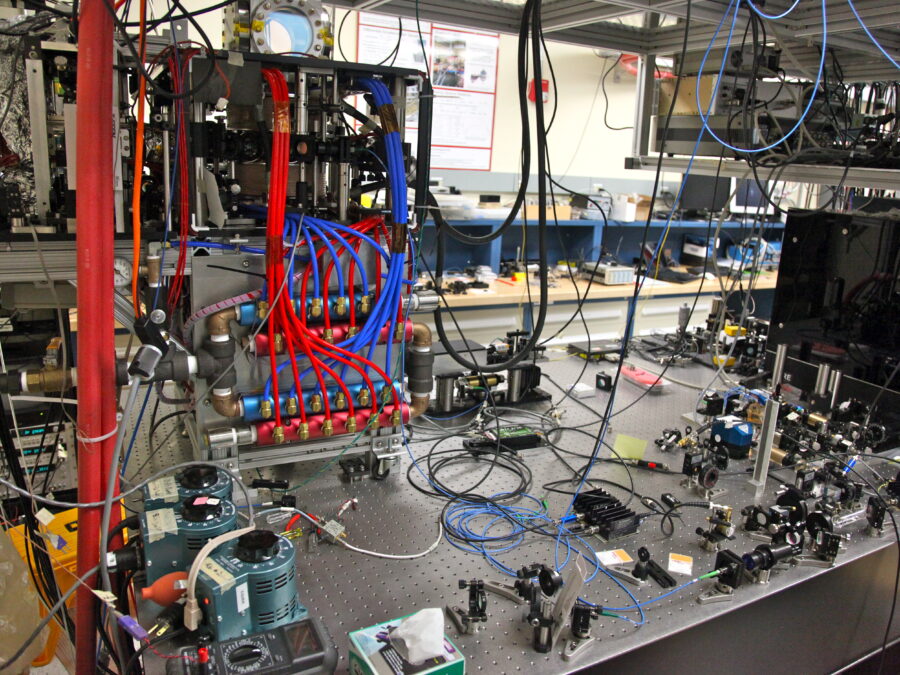
A physicist has managed to make time speed up, slow down, and stop completely — all inside a lab-built mini universe, with no external clock involved. Giovanni Barontini, at the University of Birmingham, published the findings on June 11 in Physical Review Research, aiming to answer where time actually comes from.
The question stems from the Wheeler-DeWitt equation, a foundational equation in quantum gravity that describes the universe as a single system with no outside time parameter — there’s no clock ticking away beyond it. Barontini’s hypothesis was that time isn’t a built-in ingredient of reality, but something that emerges from how things inside the universe interact with each other.
To test this, he created a Bose-Einstein condensate — a state of matter that forms only near absolute zero — using around 24,000 atoms cooled to near standstill, where they behave as a single quantum ‘super particle.’ He trapped the condensate and divided it in two with a sheet of laser light, watching only one half, called the ‘bright sector,’ while deliberately not observing the other.
As atoms flowed back and forth across the divide, occasionally spilling over completely, Barontini labelled the moments they flooded the bright side the ‘Big Bang’ and the moments they receded the ‘Big Crunch.’ Instead of relying on an outside clock, he built an ‘entropic time’ based on the flow of disorder between the two halves, using it alone to order events inside the system.
‘Time was speeding up or slowing down, or even stopping, depending on what the system was doing,’ Barontini told Live Science. The experiment also suggested that time’s forward direction comes from the same place as its existence: the act of an observer choosing to ignore part of a system, with that ignorance — measured as entropy — driving the flow of time in the part being observed.


Leave a Reply