Why Adélie Penguins Now Dive Farther to Catch the Same Krill
A study of Adélie penguins fitted with underwater trackers finds that krill move away from repeated hunting rather than being eaten to scarcity.
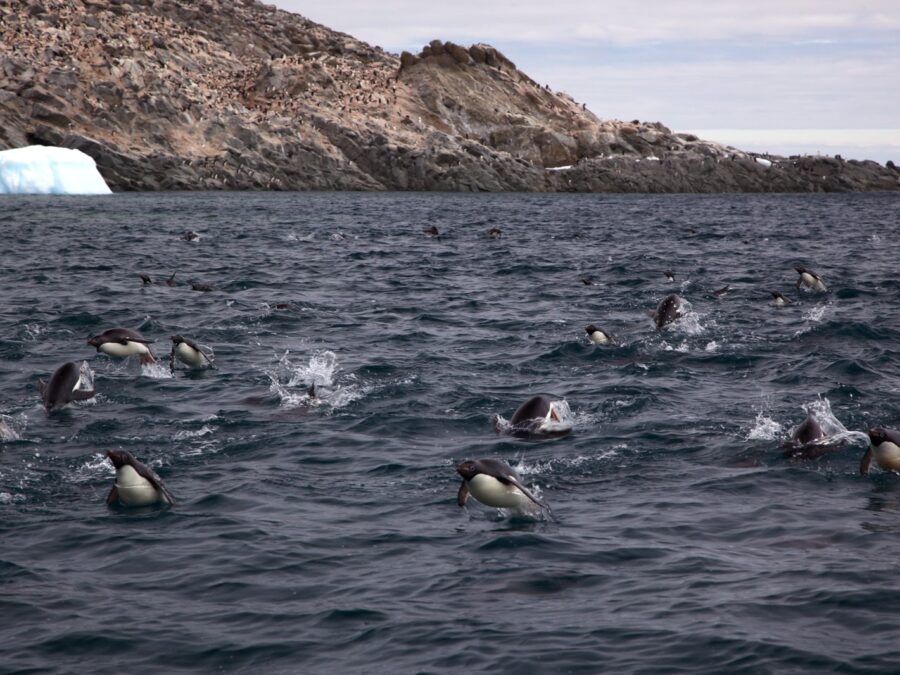
For decades, scientists studying large seabird colonies have puzzled over a phenomenon known as ‘Ashmole’s halo’ — a ring of apparent food scarcity that forms in the waters closest to a colony, forcing birds to fly or swim farther out to sea to find a meal. The usual explanation was simple: thousands of hungry birds eat most of what’s nearby, so the survivors travel farther. A new study suggests the real story is more complicated.
Researchers led by Hina T. Watanabe, a postdoctoral scholar at Japan’s National Institute of Polar Research, fitted breeding Adélie penguins in East Antarctica with bio-logging devices capable of recording dive depth, movement and feeding events in three dimensions, supported by video. Because thick sea ice covered the bay around the colony, the penguins could only enter and exit the water through a small number of shared holes, concentrating their hunting activity in the same spots.
Across 30 foraging trips and 23 tracked penguins, the team recorded more than 6,000 individual dives. The pattern that emerged was consistent: every time penguins repeatedly used the same opening in the ice, they had to dive deeper and swim farther under the water to reach prey with each subsequent trip.
Crucially, once the penguins did reach the krill, they fed at the same rate as always. If the krill population near the colony had genuinely been eaten down, feeding success should have dropped along with it. Instead, the krill appeared to simply be relocating, avoiding the areas where penguins hunted most often.
‘Food can become harder to obtain even when it has not necessarily been depleted,’ Watanabe said, describing the effect as prey accessibility rather than prey abundance shaping how the birds hunt. The same pattern held across the wider colony — penguins hunting close to the nesting site made far deeper, longer dives than those foraging farther away, even in waters that still held plenty of krill.
The study, published 15 July in the Proceedings of the Royal Society B, arrives as scientists warn that climate change, shrinking sea ice and expanding commercial krill fishing are already reshaping the Southern Ocean, adding new pressure to a food system that Antarctic penguins are already working harder to exploit.
Wikimedia Commons/by Jason Auch


Leave a Reply