The Coelacanth Was ‘Dead’ For 66 Million Years: Until A 1938 Fishing Net Said Otherwise
A fish believed extinct since the age of dinosaurs turned up alive in a South African trawler's catch in December 1938.
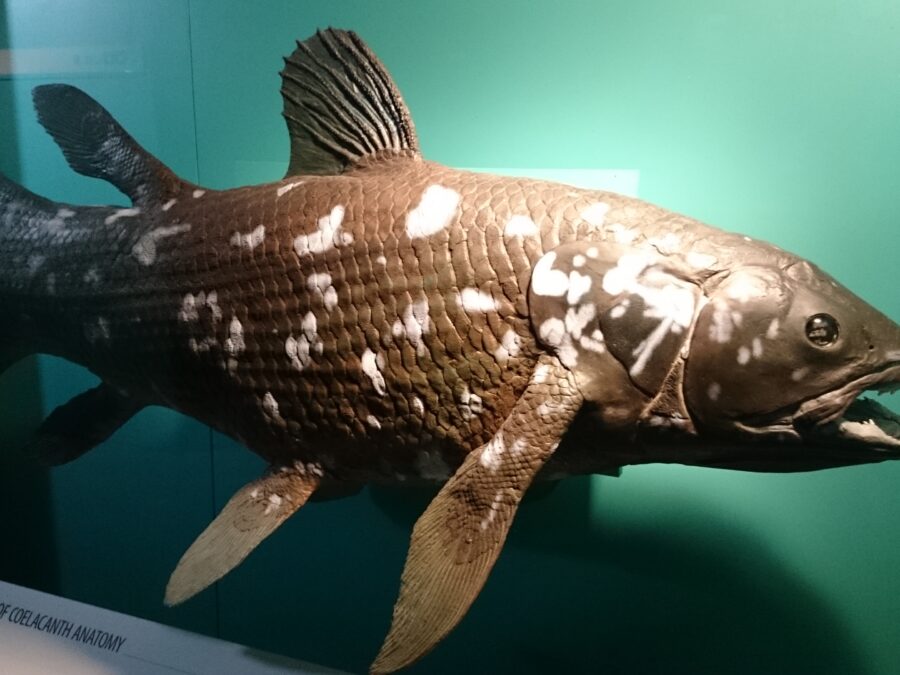
For millions of years, the coelacanth existed only in fossils, a fish believed to have lived alongside dinosaurs before disappearing from the record around 66 million years ago. Then, in December 1938, a South African fishing trawler pulled one out of the ocean, very much alive.
The specimen measured roughly 1.5 metres and stood out immediately to Marjorie Courtenay-Latimer, curator at a local museum, for its heavy, armour-like scales and unusually fleshy fins. She sent details to J.L.B. Smith, a South African ichthyologist, who confirmed weeks later that the fish belonged to a lineage known only from fossils.
Smith named the species Latimeria chalumnae in honour of Courtenay-Latimer and the Chalumna River near the discovery site, the Natural History Museum notes. What made the find so remarkable wasn’t just the age of the lineage, it was that an animal presumed extinct for tens of millions of years had survived, unnoticed, in the ocean depths.
That survival makes more sense once you consider the coelacanth’s habitat. The fish lives hundreds of metres underwater, sheltering in caves through the day and surfacing at night to hunt squid, cuttlefish and smaller fish, depths that were essentially invisible before modern underwater exploration. In the Comoros Islands, local fishermen already had a name for it, ‘gombessa’, long before scientists caught up.
Coelacanths belong to the lobe-finned fish group, with fins built around muscular lobes rather than the thin rays typical of most fish, a trait that briefly raised hopes the species was a missing link to land-dwelling vertebrates. Genetic studies later pointed to lungfish as the closer relative instead, though the coelacanth retains rare features of its own, including a flexible notochord and a skull joint that lets its mouth open unusually wide.
More coelacanths surfaced after 1938, a second specimen in the Comoros Islands in 1952, and a coelacanth found at an Indonesian market in 1997 that turned out to be a distinct species, Latimeria menadoensis. Each discovery added to a picture of a lineage that, despite the ‘living fossil’ tag, has kept quietly evolving all along.
Wikimedia Commons/by Nkansah Rexford

Leave a Reply