A 400-Year-Old Shark’s Eyes Are Giving Scientists Clues About Human Vision Loss
Greenland sharks can live up to 400 years without their retinas showing signs of age-related damage, a discovery scientists say could help treat human eye disease.
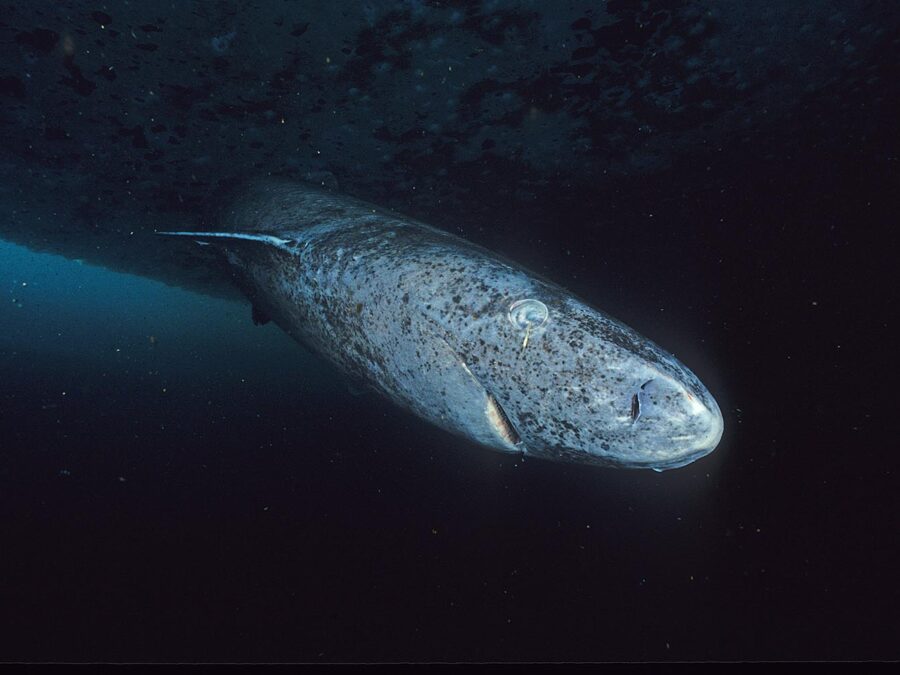
Greenland sharks, animals capable of living up to 400 years, appear to keep their retinas in near-perfect condition for centuries — a discovery scientists say could eventually help treat age-related vision loss in humans.
For years, researchers assumed the sharks were functionally blind. They live in the pitch-dark waters of the Arctic, and their eyes often look cloudy with parasites dangling from the cornea. That changed when Dorota Skowronska-Krawczyk, an associate professor at the University of California, Irvine, watched footage of a shark drifting through dark water and noticed it actively tracking the light with its eyeball — not the behaviour of a blind animal.
To investigate, researchers collected Greenland sharks near Disko Island in Greenland between 2020 and 2024 and sent preserved eye tissue to Skowronska-Krawczyk’s lab. PhD student Emily Tom examined the tissue using histological analysis and found no evidence of cell death in the retina. Rhodopsin, a protein essential for seeing in dim light, was fully functional and tuned to detect blue light, the wavelength that penetrates deepest underwater.
The results, published in Nature Communications under the title ‘The visual system of the longest living vertebrate, the Greenland shark,’ were co-authored with University of Basel researchers Walter Salzburger and Lily G Fogg. The study identifies a DNA repair mechanism that appears to shield the shark’s retina from age-related damage.
In humans, the eye is often among the first organs to show signs of ageing, contributing to conditions like macular degeneration and glaucoma. Skowronska-Krawczyk believes the implications go beyond shark biology — long-lived animals like this one offer a rare natural experiment in how tissue can resist ageing, one that could eventually inform new approaches to human eye disease.





Leave a Reply