Italy’s 2,500-year-old cemetery shows a civilisation historians barely have records of
A rare aristocratic burial ground unearthed in Sirolo, Italy is helping researchers piece together the little-documented Piceni civilisation, whose graves remain one of the few sources of information about them.
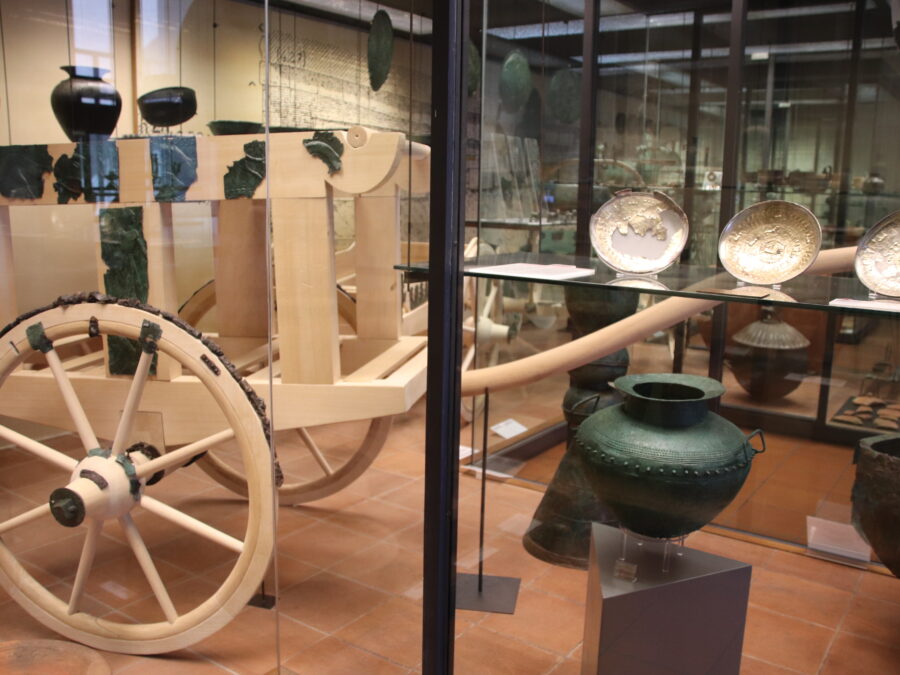
Most of what we know about the ancient Piceni comes not from anything they wrote, but from what they buried. The civilisation, which ruled Italy’s Adriatic coast during the sixth century BC, left behind almost no written records, forcing archaeologists to rely almost entirely on excavation to understand how it lived, and how it honoured its dead.
That gap in the historical record just got a little smaller. On July 1, the Superintendency of Archaeology, Fine Arts and Landscape for the Provinces of Ancona, Pesaro and Urbino announced the discovery of a sixth-century BC burial complex in Sirolo believed to belong to the Piceni’s ruling class, a people who bordered the more thoroughly documented Etruscans to the north.
At the centre of the site, inside a large circular wooden enclosure, sat the grave of a man buried with an intact wooden two-wheeled chariot known as a currus, a helmet, an axe and bronze vessels sealed with ceramic lids that are thought to have held a funeral feast or offerings for the afterlife.
A second grave beside his held a woman buried with textiles, shoes and fibulae, the metal pins ancient people used to fasten clothing, including one large piece inlaid with amber found near her head. Her burial lies close to the Queen’s Tomb, a 1989 find that contained a Piceni woman buried with two chariots and two mules.
Unlike earlier Piceni burial grounds, typically marked off by a ditch, this cemetery was enclosed by a wooden palisade and situated on a small hill, a layout researchers say was likely intended to signal its importance. It follows an earlier 2020 discovery in the same cemetery, and together the finds mark the first time archaeologists have identified an entire aristocratic nucleus of the Piceni civilisation.



Leave a Reply